
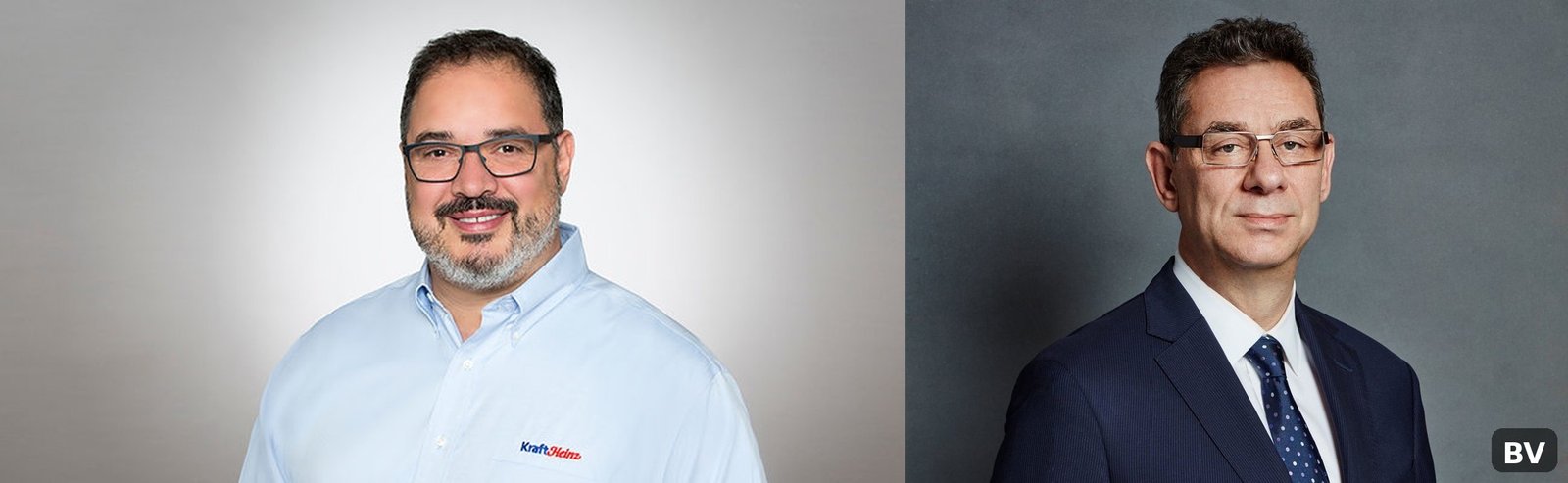
In January 2019, Pfizer handed its keys to a Greek veterinarian who had never worked at any other company in his life. Six months later, Kraft Heinz bet its survival on a Portuguese brand-builder who had spent two decades selling beer across four continents. Two of the most consequential CEO appointments in modern corporate America landed in the same calendar year — and ever since, search engines have kept pairing their names.
The question behind most of those searches is a simple one: are Miguel Patricio and Albert Bourla actually connected? The short answer is no — not as partners, not as relatives, not as colleagues. But the reason their names keep appearing side by side is more interesting than a coincidence. It is the story of two men handed the hardest jobs in American business in the same year, armed with two completely different playbooks.
This article lays out what is genuinely known about both men: their careers from the beginning, the honest answer on their money, why their names are linked in the first place, and where each of them stands today. No speculation and no invented figures — just the public record, examined properly.
Quick Bio
| Miguel Patricio | Albert Bourla | |
|---|---|---|
| Full Name | Miguel Patricio | Albert Bourla |
| Known For | CEO of Kraft Heinz (2019–2023) | Chairman and CEO of Pfizer |
| Birth Year | 1966 | 1961 |
| Age in 2026 | 60 | 64 |
| Nationality | Portuguese | Greek-American |
| Profession | Consumer-goods executive, marketer | Veterinarian, pharmaceutical executive |
| Estimated Net Worth | Never publicly disclosed | Published estimates range from about $26M to $80M (unverified) |
| Current Status | Board member at Kraft Heinz and AB InBev | Chairman and CEO of Pfizer |
So, Are Miguel Patricio and Albert Bourla Actually Connected?
Let us answer the question directly, because everything else follows from it. There is no public evidence that Miguel Patricio and Albert Bourla have ever worked together, done business together, or share any family connection. Patricio is a Portuguese national whose career ran through consumer products and beverages. Bourla was born in Thessaloniki, Greece, and spent more than three decades inside a single pharmaceutical company. Their employers never overlapped, their industries never overlapped, and their educations could hardly be more different.
So why do their names appear together so often? The simplest reason is timing. Both men were appointed chief executive of major American public companies in 2019 — Bourla at Pfizer in January, Patricio at Kraft Heinz in July. That puts them in the same cohort of CEO rankings, executive compensation studies, and leadership retrospectives, which is where search engines and business writers keep pairing them.
There is a second, subtler reason. Both appointments were widely read as turning points. Kraft Heinz was in genuine distress when Patricio arrived, and Pfizer was about to face the defining test of its modern history when Bourla took over. Two outsiders-by-background, given the hardest seats in the room in the same year — that contrast is genuinely interesting, and it is the real connection between them. Everything else is noise.
Miguel Patricio: The Brand Builder From Portugal
Miguel Patricio was born in Portugal in 1966 and studied business administration at Fundação Getulio Vargas in São Paulo, Brazil. That Brazilian education would shape the geography of his entire career: he became one of that rare breed of executives who built brands on every continent.
His early years ran through the classic training grounds of consumer marketing — senior roles at Johnson & Johnson, Coca-Cola, and Philip Morris. In 1998 he joined Ambev, the Brazilian brewer, and became its chief marketing officer a year later. When Ambev merged into the business that became AB InBev, Patricio kept rising: Zone President for North America, then Zone President for Asia Pacific, where he was credited with turning around the company’s China business.
From 2012 to 2018 he served as AB InBev’s Global Chief Marketing Officer, running the strategic playbook for Budweiser, Corona, and Stella Artois. In his final year as chief marketer, AB InBev was the most awarded brand owner at the Cannes Lions festival — a detail Kraft Heinz would later cite when it hired him. He had become, in the words of Kraft Heinz chairman Alex Behring, one of “the best brand-building minds in the industry.”
Kraft Heinz announced his appointment in April 2019, and he took the chief executive’s office on July 1, succeeding Bernardo Hees. He inherited a company in real trouble: a 36% dividend cut, a $15 billion brand writedown, an SEC investigation into its accounting, and a share price that had roughly halved since the Kraft-Heinz merger. The 3G Capital playbook of relentless cost-cutting had run its course, and the brands were bleeding.
Patricio’s answer was to do the opposite of what his predecessors had done. He pushed marketing investment back up, reorganized more than 55 product categories into six consumer-focused platforms, reshaped the portfolio, cut debt, and tried to rebuild a company culture that had been hollowed out. In 2020 the company unveiled a broad strategic transformation plan built around consumers rather than costs. It was slow, unglamorous work — and analysts at the time were openly skeptical that a marketer could fix what years of financial engineering had broken.
His exit was announced as a planned succession. Patricio stepped down as CEO at the end of 2023, and Carlos Abrams-Rivera — already a senior leader inside the company — took over in January 2024. Patricio stayed on as Non-Executive Chair, then became Executive Chair in September 2025 as Kraft Heinz worked on a proposed separation into two public companies. That role was temporary: his term as chair ended in December 2025, with John T. Cahill becoming independent chair on January 1, 2026, and Steve Cahillane taking the CEO’s office. Patricio continues to serve as a Kraft Heinz board member, and he remains on the board of AB InBev.
Albert Bourla: The Veterinarian Who Ran a Pharma Giant
Albert Bourla was born in Thessaloniki, Greece, in 1961, into a family with deep roots in the city’s history. His path to the top of Pfizer began not in a business school but in veterinary medicine: he earned his Doctor of Veterinary Medicine and then a Ph.D. in the Biotechnology of Reproduction from the Aristotle University of Thessaloniki.
He joined Pfizer’s Animal Health division in Greece in 1993 and never left the company. Over the next two and a half decades he moved steadily upward and outward: international management roles, then leadership of the human-health businesses — Established Products, and later Group President of Vaccines, Oncology and Consumer Healthcare. By 2016 he was running Pfizer Innovative Health, one of the company’s core growth engines. He became chief operating officer in January 2018, and CEO in January 2019, succeeding Ian Read. He added the chairman’s title in 2020.
Early in his tenure, Bourla set out to make Pfizer a more focused, science-driven company. Upjohn, the off-patent medicines business, was separated and combined with Mylan. The consumer-health business went into a joint venture with GSK. Research and development spending rose, and the company organized itself around what it called its Purpose Blueprint — Courage, Excellence, Equity, and Joy.
Then came the test that defined his career. Pfizer partnered with BioNTech to develop an mRNA vaccine for COVID-19, compressing research, clinical trials, manufacturing, regulatory approval, and global distribution into a schedule no one had thought possible. The program made Pfizer the public face of the pandemic response and drove the company’s value past $300 billion at its peak — while also placing Bourla under intense scrutiny over supply, access, and pricing.
The post-pandemic years brought a different kind of challenge. With COVID revenues fading and patent expirations threatening up to $18 billion in revenue between 2025 and 2030, Bourla went shopping: the $43 billion acquisition of Seagen in 2023 rebuilt Pfizer’s oncology franchise, and the 2025 acquisition of Metsera — valued at up to $10 billion — pushed the company into obesity treatments. Pfizer invested $10.4 billion in internal R&D in 2025 and reported full-year revenue of about $62.6 billion.
Bourla also spent 2025 navigating Washington. In September, Pfizer became the first drugmaker to sign a voluntary most-favored-nation pricing agreement with the Trump administration, offering discounts of 50% to 85% on certain products through the government’s TrumpRx platform in exchange for a three-year grace period from pharmaceutical tariffs. The company pledged $70 billion toward U.S. manufacturing and research. Late in 2025, Pfizer’s governance committee reviewed the leadership structure and concluded it was in shareholders’ best interests for Bourla to continue as chairman — and he remains both chairman and CEO today.
Away from the office, Bourla is married to Myriam Alchanati Bourla. The couple have two children, a son and a daughter, and live in Scarsdale, New York. In a detail that says a great deal about him, he has never in his professional life worked for any company other than Pfizer.
Two CEOs, Two Very Different Playbooks
Put the two careers side by side and the contrast is the story. Patricio is the itinerant brand-builder: four continents, half a dozen employers, a marketer who learned to run businesses and then returned to marketing at global scale. Bourla is the institutional man: one company, one ladder, a scientist who learned commerce from the inside and climbed every rung of it.
Both inherited genuinely hard situations in 2019, but the hard was different. Patricio walked into a company whose problems were of its own making — a merger that had prioritized cost-cutting over brands until the brands broke. His job was repair. Bourla walked into a giant whose biggest test had not yet arrived — and when it did, his job was speed.
Their leadership signatures reflect those origins. Patricio’s Kraft Heinz was about the consumer: marketing spend, brand platforms, culture, patience. Analysts who interviewed his former colleagues praised his management approach while openly questioning whether marketing alone could revive the portfolio — a fair skepticism that his tenure never fully resolved. Bourla’s Pfizer was about urgency: the company claims the operating tempo of its COVID years permanently changed how it runs research programs, and his dealmaking since has been aggressive and expensive.
It is worth saying plainly what the scorecards show. Patricio stabilized Kraft Heinz, rebuilt its marketing muscle, and handed over a functioning succession — real achievements at a company that looked broken in 2019. Bourla led one of the great corporate mobilizations of the century and then faced the classic pharma problem of replacing the revenue it created. Neither story is a simple triumph or a failure. As Beverly Magazine has noted in its coverage of executive careers, the most interesting leaders are rarely the ones with the cleanest narratives — they are the ones whose records invite argument.
The Money Question: What Their Fortunes Are Actually Worth
Executive wealth is one of the most misreported subjects on the internet, so here is what the public record actually supports — and what it does not.
Albert Bourla’s compensation is a matter of public filing, and the numbers are large. For 2025, Pfizer reported total compensation of $27.6 million, up from $24.6 million in 2024: a $1.8 million base salary, a $5.4 million annual bonus, $9.4 million in stock awards, $9 million in option awards, and $1.9 million in other compensation — including about $610,000 for security, which Pfizer attributed to heightened threats against its executives. Roughly 92% of his pay is performance-based.
His net worth, however, has never been officially disclosed, and published estimates disagree sharply. Celebrity-finance outlets have put the figure at around $26.4 million, while other published profiles have suggested a range of $50 million to $80 million, citing his accumulated Pfizer stock and years of eight-figure compensation. Treat every one of those figures as an estimate, not a fact: without access to his private holdings, no outsider can do better than a range.
Miguel Patricio’s finances are even less visible. His 2019 Kraft Heinz offer letter — filed publicly with the SEC — set a $1 million base salary with a bonus target of 300% of base, and published reports at the time put his annual compensation at roughly $11 million. But no reliable outlet has ever published a net-worth estimate for him, and inventing one would be dishonest. What can be said is this: SEC filings show that as Executive Chair he sold 250,000 Kraft Heinz shares in December 2025 for about $6.2 million, and still held roughly 1.29 million shares afterward — a disclosed stake worth in the region of $30 million at the sale price. That illustrates the scale of his holdings; it is not a net-worth figure, and it should not be presented as one.
The honest summary: Bourla’s wealth is best described as a published-estimate range of roughly $26 million to $80 million, and Patricio’s has never been made public at all. Anyone who gives you a single confident number for either man is guessing.
Where Miguel Patricio and Albert Bourla Stand Today
As of 2026, their paths have diverged in the way the table above suggests. Bourla remains firmly in the arena: still chairman and CEO of Pfizer, still steering the company through its patent-cliff years, still one of the most closely watched executives in global healthcare. The board’s late-2025 decision to keep him in the chairman’s seat was an explicit vote of confidence.
Patricio has moved into the second act that many long-serving CEOs choose: boardrooms rather than corner offices. He sits on the boards of both Kraft Heinz and AB InBev — the two companies that defined his career — without the day-to-day weight of running either. It is a quieter role, and by all public accounts, a deliberate one.
Bottom Line
Miguel Patricio and Albert Bourla are not connected by business, blood, or history. They are connected by a moment: the year 2019, when two great American companies each decided that the person to lead them into the next decade was someone who did not look like the obvious choice. One was a marketer in a cost-cutter’s chair; the other was a veterinarian in a pharma titan’s chair.
What happened next — a brand turnaround in Chicago, a vaccine that changed the world from New York — belongs to the record now. Their names will keep appearing together in rankings and retrospectives, and that is fine. Just remember what the pairing actually means: not a partnership, but a study in contrast. Two men, two industries, two playbooks, one remarkable year.
Are Miguel Patricio and Albert Bourla related?
No. There is no reliable public evidence of any family relationship between them. Patricio is Portuguese; Bourla was born in Greece to a Greek family. The similarity people notice is professional, not personal.
Did Miguel Patricio and Albert Bourla ever work together?
No. Public corporate records show no shared employer, joint venture, or direct professional relationship. Patricio’s career ran through consumer goods and beverages (AB InBev, Kraft Heinz); Bourla has spent his entire career at Pfizer.
Why do Miguel Patricio and Albert Bourla appear together in search results?
Both became CEOs of major U.S.-listed companies in 2019 — Bourla at Pfizer in January and Patricio at Kraft Heinz in July. That puts them in the same executive rankings, compensation studies, and leadership discussions, which is where the pairing comes from.
What is Albert Bourla’s net worth?
It has never been officially disclosed. Published estimates range from about $26.4 million to as high as $80 million, based on his Pfizer compensation — $27.6 million in total pay for 2025 — and accumulated stock. All figures should be treated as estimates.
What is Miguel Patricio’s net worth?
It has never been made public, and no reliable published estimate exists. SEC filings show he held roughly 1.29 million Kraft Heinz shares after a December 2025 sale, a disclosed stake worth around $30 million at the sale price — but that is not a full net-worth figure.
Is Albert Bourla still CEO of Pfizer?
Yes. He remains both Chairman and CEO of Pfizer in 2026, after the company’s governance committee decided in late 2025 that he should continue in the chairman’s role.
