

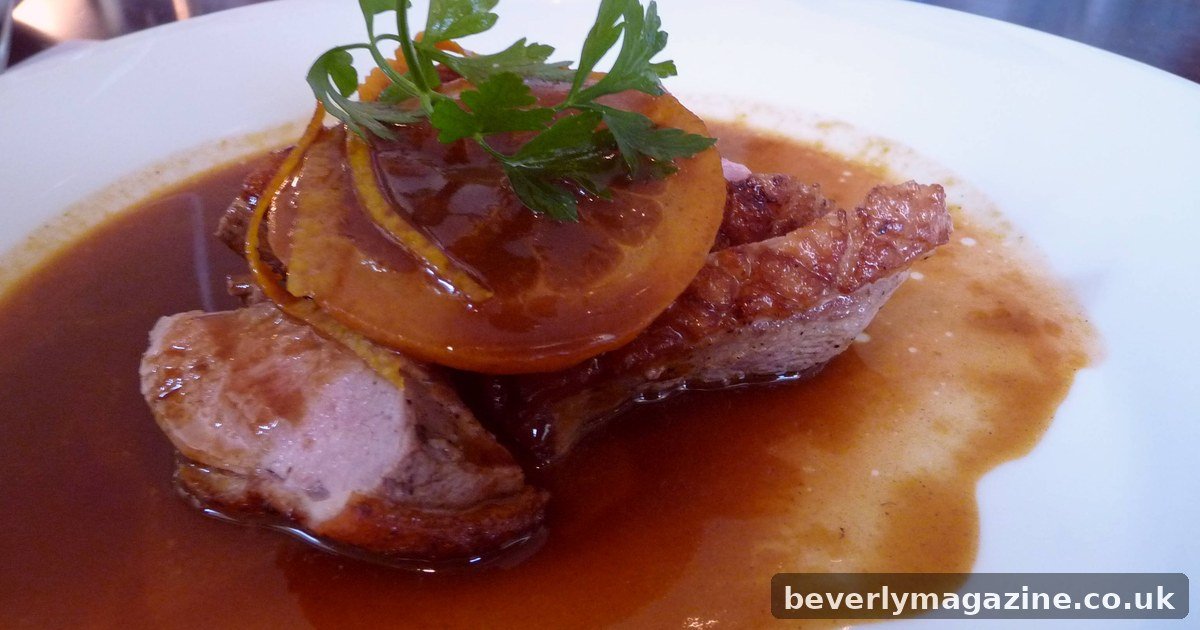
Few dishes announce “special occasion” like duck à l’orange: burnished, crackling-skinned roast duck, carved tableside if you are lucky, napped in a glossy bitter-orange sauce that is sweet, sharp, and savory all at once. It is the poster child of classic French cooking — and also one of the most misunderstood dishes on restaurant menus. This guide explains what authentic duck à l’orange is, how to spot a great one, and how to find the best duck à l’orange near you.
What Is Duck à l’Orange?
At its core, duck à l’orange is roast duck served with a sauce built from caramel, vinegar, orange juice, and stock, finished with butter and traditionally made with bitter Seville oranges (bigarade). The duck itself is roasted until the thick layer of subcutaneous fat has rendered out, leaving the skin crisp and the meat rich and succulent. The sauce — sweet from caramelized sugar, sharp from vinegar and citrus, deep from brown stock — is designed to cut through the duck’s fattiness. It is a balancing act, and when it works, it is one of the great sweet-savory pairings in all of cooking.
The dish’s history runs deep. Pairing fruit with rich meat was standard practice in medieval European cooking, and the orange-and-duck combination took root in France centuries ago. One well-known thread traces it to the 16th century, when Catherine de’ Medici married into the French royal family in 1533 and brought Italian cooks and their sweet-sour techniques to the French court. By the 17th and 18th centuries it was established in French grande cuisine, and in the 19th century it appeared in French cookery books — including Louis Eustache Ude’s The French Cook, with his ducklings à la bigarade (bigarade being the bitter orange). It crossed the Atlantic and became a defining fancy-restaurant dish in the United States in the 1960s. Today it is enjoying a quiet revival as diners rediscover classical technique.
Bigarade: the bitter orange that makes it
Traditional recipes insist on bitter Seville oranges rather than sweet navel oranges. The bitterness gives the sauce its characteristic edge — the “sophisticated” quality that keeps it from tasting like dessert. Many modern restaurants use a mix of sweet orange juice and zest with vinegar to approximate the effect when Seville oranges are out of season (they are a winter fruit). Either way, if the sauce tastes like pancake syrup with orange flavoring, something has gone wrong.
What Makes a Great Duck à l’Orange?
This is a technically demanding dish, which is exactly why quality varies so much. Here is what excellence looks like:
- Crisp, rendered skin. Non-negotiable. Duck carries a thick fat layer, and a great kitchen renders most of it out so the skin shatters like glass. Flabby, rubbery skin means the duck was under-roasted or steamed in its own fat.
- Moist, rosy meat. Duck breast is best served pink — overcooked duck is dry and livery. A whole roast duck should still be juicy; duck legs confit-style tender.
- Sauce with three dimensions. You should taste sweetness (caramel), acidity (vinegar and orange), and savory depth (stock) in balance, with a glossy, butter-mounted finish that coats the meat without drowning it. One-note sweet sauce is the most common failure.
- Real orange character. Look for visible zest, perhaps supremed orange segments as garnish, and a genuine citrus perfume — not orange extract.
- Restraint in portioning and sides. Classic accompaniments are simple: roasted potatoes, glazed vegetables, maybe a bitter salad. Heavy sides or towering garnishes usually mean the kitchen is compensating.
Whole duck vs. duck breast
Traditional presentations use a whole roast duck, carved in the dining room. Many modern restaurants serve duck breast (magret) with the orange sauce instead — quicker, easier to cook perfectly pink, and less wasteful. Both can be excellent. Do not dismiss the breast version as inauthentic; some of the best duck à l’orange in any city is served that way. What matters is the skin, the sauce, and the cooking — not the butchery format.
The 1960s cliché trap
Duck à l’orange suffers from its own fame. In lesser hands it became a punchline: over-sweet sauce from a mix, soggy skin, canned mandarin segments. The revival versions worth seeking out treat it as a serious classical dish again — house-made stock, real caramel, proper bitter orange. Menus that describe the sauce’s components in detail (“Seville orange gastrique, duck jus”) are signaling that they are in the serious camp.
How to Find the Best Duck à l’Orange Near You
1. Target French restaurants — specifically classical ones
Search “duck à l’orange near me,” “French restaurant near me,” and “canard à l’orange near me.” Bistros doing steak-frites and onion soup may or may not attempt it; restaurants that describe themselves as classical French, or whose menus include other old-school dishes (sole meunière, beef bourguignon, soufflé), are far more likely to execute it properly.
2. Read the menu description carefully
Good signs: mention of bigarade or Seville orange, gastrique, duck jus, or specific technique (“crisp-skinned,” “confit leg”). Warning signs: the dish buried in a “classics” section with no description, or described only as “duck with orange sauce.” Vagueness usually means it is an afterthought.
3. Look at the photos like a technician
In customer photos, zoom in on the skin — you want to see deep golden-brown, lacquered crispness, not pale soft skin. The sauce should look glossy and coat the meat; a thin watery pool or a neon-orange glaze are both bad signs. Bonus points for visible orange segments or zest as garnish.
4. Consider the occasion and the price
Duck à l’orange is labor-intensive: rendering a duck properly and building a real gastrique-based sauce takes time and skill. Suspiciously cheap versions cut corners somewhere — usually the sauce. This is a dish where paying the proper price at a serious kitchen is part of the experience. Many restaurants offer it as a dish for two, carved tableside; if you see that option, take it.
5. Ask about the orange
A confident, specific question: “Do you use bitter oranges in the sauce?” Kitchens doing it right will light up and tell you about their Seville orange supplier or their gastrique method. Kitchens doing it wrong will look confused. It is the duck-à-l’orange equivalent of asking a barbecue joint about its wood.
FAQs About Duck à l’Orange
What does duck à l’orange taste like?
Rich, savory roast duck with crisp skin, balanced by a sauce that is simultaneously sweet (caramel), tart (orange and vinegar), and deeply savory (brown stock and butter). The overall effect is luxurious but not heavy — the acidity keeps cutting through the fat.
Is duck à l’orange actually French?
Yes, in its classic form it is a cornerstone of French grande cuisine, codified in French cookery from the 17th through 19th centuries. Its roots trace back further, through Italian sweet-sour cooking brought to the French court in the 1500s and the medieval European tradition of pairing fruit with game meats.
What is the difference between duck à l’orange and orange chicken?
They share nothing but citrus. Orange chicken is a Chinese-American dish of battered fried chicken in a sweet-spicy glaze. Duck à l’orange is French roast duck with a bitter-orange gastrique sauce — savory, classical, and built on stock and caramel rather than a sweet coating.
What wine goes with duck à l’orange?
Classic pairings are Pinot Noir (Burgundy is traditional), or a Syrah-based red with enough fruit to meet the sauce. The wine needs acidity and red fruit — heavy, tannic wines fight the orange. When in doubt, ask the sommelier; this is exactly the dish they love pairing.
Can I make duck à l’orange at home?
Yes, with patience. The keys are: prick and slowly render the duck skin before roasting, make a real gastrique (caramel deglazed with vinegar, then orange juice and stock reduced), and finish with cold butter. Duck breast is the friendlier home-cook format — score the skin, start skin-down in a cold pan, and cook mostly on the skin side.
Complete the roast-dinner table: our guides to the best rotkohl with apples near you and the best pork crackling with apple sauce near you.
The Bottom Line
The best duck à l’orange near you will have shattering-crisp skin, juicy meat, and a sauce that balances caramel sweetness against bitter orange and vinegar — never one-note, never syrupy. Find it at classical French kitchens that describe their technique with pride, inspect the photos for that lacquered skin, and do not be afraid to ask about the oranges. Done right, it earns every bit of its legendary reputation.
