

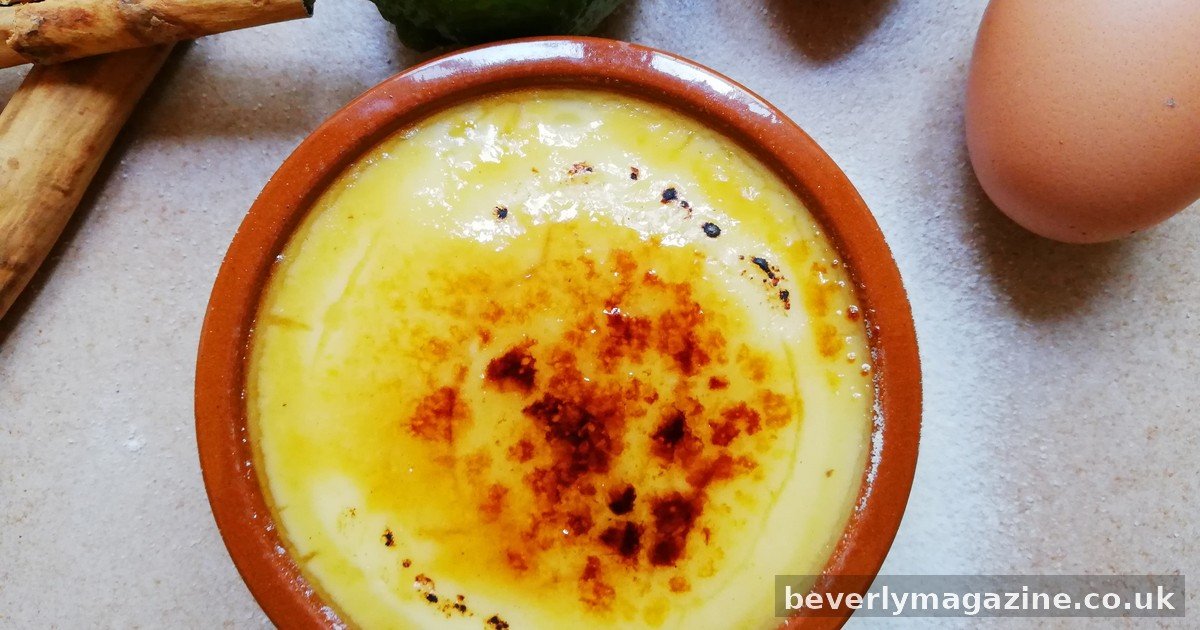
If you’re hunting for the best crema catalana near me, you’re chasing one of Europe’s great desserts — and one of its oldest. Beneath a shattering layer of caramelized sugar sits a silky custard perfumed with cinnamon and lemon, lighter and brighter than anything France ever put a torch to. The problem? Plenty of places serve something they call crema catalana that tastes like sweet milk pudding with burnt sugar on top.
This guide covers what authentic crema catalana actually is, how it differs from its famous French cousin, what separates a great one from a forgettable one, and how to find the real thing near you.
What is crema catalana?
Crema catalana — literally “Catalan cream,” also known as crema cremada (“burnt cream”) or crema de Sant Josep — is a traditional dessert from Catalonia in northeastern Spain. At its simplest, it’s a custard made from milk, egg yolks, and sugar, flavored with cinnamon and lemon zest, with a thin layer of caramelized sugar on top that you crack through with your spoon.
The technique is part of what makes it special. Unlike crème brûlée, which is baked in a water bath, crema catalana is cooked gently on the stovetop until it thickens, then poured into shallow dishes to set as it cools. The sugar topping was traditionally caramelized by pressing a red-hot iron disk — a cremador — onto the surface. Modern kitchens usually reach for a blowtorch or a hot grill, but the goal is the same: a glassy, bitter-edged crust over cool, fragrant custard.
One of Europe’s oldest desserts
Crema catalana has a serious claim to being one of the oldest custard desserts still eaten in Europe. Precursors appear in the 14th-century Catalan cookbook Llibre de Sent Soví and the 16th-century Llibre del Coch. The name “crema catalana” shows up in a 1745 cookbook by the friar Juan de Altamiras, and the burnt-sugar topping is documented from 1770. It was long associated with Saint Joseph’s Day on March 19th — hence crema de Sant Josep — though these days Catalans eat it all year round.
Crema catalana vs. crème brûlée
The two desserts look like twins, but they taste like cousins. Here’s the honest breakdown:
- The base: crema catalana is made with milk; crème brûlée is made with cream (sometimes enriched further). The Catalan version is lighter and less rich.
- The flavoring: crema catalana is invariably flavored with cinnamon and lemon zest (sometimes orange too). Crème brûlée is typically vanilla.
- The method: crema catalana is cooked on the stovetop and sets as it cools; crème brûlée is baked in a bain-marie.
- The texture: crema catalana is a touch looser and more pudding-like; crème brûlée is denser and firmer.
Neither is “better” — but if a menu offers you vanilla custard with a torched top and calls it crema catalana, it’s really serving crème brûlée with a Spanish name.
What makes a great crema catalana?
A short ingredient list means every detail matters. Here’s how to tell the exceptional from the ordinary.
The custard
- Silky, never grainy or rubbery. The custard should be smooth and spoonable. Graininess means the eggs were overheated; rubberiness means it was baked like a crème brûlée instead of set gently.
- Cinnamon and lemon you can actually taste. The defining flavors of crema catalana are warm cinnamon and bright lemon zest. If all you taste is sweetness, the kitchen skipped the infusion — or didn’t infuse long enough.
- Not too sweet. Great crema catalana is delicately sweet, because the caramelized top adds its own bitter-sweetness. An overly sweet custard plus a sweet crust is cloying.
- Real ingredients. Milk, egg yolks, sugar, cinnamon stick, lemon peel — that’s the canon. Cornflour (cornstarch) appears in many modern recipes as a thickener and is perfectly legitimate, but the flavor should still come from the aromatics, not vanilla essence.
The caramelized top
- Thin and even. The sugar layer should be a delicate sheet that cracks cleanly under your spoon — not a thick, chewy slab and not patchy burnt spots.
- Caramelized to order. The sugar should be torched shortly before serving. A crust that’s been sitting for hours softens and weeps, losing the all-important crack.
- Bitter edges welcome. A proper caramelization has hints of bitterness that balance the sweet custard. Pale, barely-melted sugar is underdone.
The serving
Traditionally, crema catalana is served in wide, shallow earthenware dishes, which maximize the ratio of crackly top to creamy custard. It’s typically served cool — many restaurants chill it, though room temperature is also traditional. Either way, it should never arrive warm from the kitchen unless it was just set.
How to find the best crema catalana near you
Authentic crema catalana is harder to find than crème brûlée, because fewer kitchens outside Spain make it. But it’s absolutely out there if you know where to look.
1. Start with Spanish and Catalan restaurants
This is the obvious first move, and it works. Spanish restaurants — especially Catalan ones, or those with a regional Spanish focus — are the most likely to make crema catalana properly. Tapas bars with a serious dessert menu are strong candidates. Check the dessert section of online menus before you go; if “crema catalana” is listed, you’re in business.
2. Read the description, not just the name
Menus tell the truth if you read closely. Look for mentions of cinnamon, lemon, or “Catalan-style.” Be wary of any “crema catalana” described with vanilla — that’s the telltale sign of a crème brûlée wearing a false mustache. A menu that bothers to describe the dessert properly usually reflects a kitchen that bothers to make it properly.
3. Search reviews and photos for the crack
Search reviews for “crema catalana” specifically, and look at diner photos. You want to see a thin, amber, glassy sugar top — ideally with a spoon mid-crack. Reviews mentioning cinnamon, lemon, or “not too sweet” are excellent signs. Reviews that just say “the crème brûlée was good” at a Spanish restaurant suggest the kitchen may be serving the French version under either name.
4. Try Spanish bakeries and delis
Some Spanish bakeries, delicatessens, and specialty food shops sell crema catalana to take home, particularly around March for Saint Joseph’s Day. These are often made in the traditional style and can be superb. Ask at the counter when it was made — freshness matters for the crust.
5. Ask about the method
A quick question separates the serious from the sloppy: “Is your crema catalana made with cinnamon and lemon?” or “Do you caramelize the sugar to order?” A confident yes to both is a very good sign. If the server looks blank, the dessert probably came from a tub.
6. Make it yourself as a benchmark
Crema catalana is one of the more forgiving classic desserts to make at home: infuse milk with cinnamon and lemon peel, whisk with egg yolks, sugar, and a little cornstarch, cook gently until thick, chill, then torch sugar on top just before serving. Even one homemade batch will calibrate your palate — you’ll instantly recognize the real thing (and the fakes) in restaurants afterward.
Crema Catalana FAQ
Is crema catalana the same as crème brûlée?
No, though they’re close relatives. Crema catalana uses milk instead of cream, is flavored with cinnamon and lemon rather than vanilla, and is cooked on the stovetop rather than baked in a water bath. It’s lighter, brighter, and a little looser in texture.
What does crema catalana taste like?
Cool, silky custard with warm cinnamon and fresh lemon notes, topped with a thin sheet of bitter-sweet caramelized sugar that shatters when you tap it. It’s sweet but balanced — the citrus and the caramel’s edge keep it from being heavy.
Why is it called crema de Sant Josep?
It was traditionally served on Saint Joseph’s Day, March 19th, which is why many Catalans still call it crema de Sant Josep. These days it’s eaten year-round, but you’ll see it everywhere in Catalonia in mid-March.
Is crema catalana gluten-free?
Traditionally, yes — the classic ingredients (milk, egg yolks, sugar, cinnamon, lemon) contain no gluten. Some modern recipes use cornstarch as a thickener, which is also gluten-free, but if you have coeliac disease it’s always worth checking with the restaurant, as flour is sometimes used.
Can you make crema catalana without a blowtorch?
Yes. The traditional method used a red-hot iron disk, and a very hot oven grill (broiler) works too — you sprinkle sugar over the chilled custard and grill it briefly until it melts and browns. Watch it like a hawk; it goes from perfect to burnt in seconds.
How long does crema catalana keep?
The custard base keeps well in the fridge for two to three days, covered. But the caramelized top should always be done just before serving — once torched, the sugar should be torched shortly before serving. A crust that’s been sitting for hours softens and weeps, losing the all-important crack.
More from Spain: our guides to the best pisto manchego near you and the best ajo blanco near you.
Conclusion
The best crema catalana near you is the one that respects the canon: milk-based custard infused with real cinnamon and lemon, set silky-smooth, and finished with a thin, bitter-edged sugar crust caramelized to order. Start with Spanish and Catalan restaurants, read menus and reviews with a detective’s eye, and don’t accept vanilla custard in disguise. And if the search comes up empty, make a batch at home — it’s simpler than it looks, and one taste of the real thing will make you a lifelong judge of everyone else’s.
